
What untreated patella luxation can cause
A slipping kneecap can lead to joint wear and lameness over time.
Patella luxation means the kneecap slips out of the groove it should glide in. It is markedly common in small breeds — Yorkshire terriers, chihuahuas, poodles, pomeranians — and often traces back to congenital anatomy: a shallow groove, a rotated femur, or an abnormal ligament attachment.
Owners rarely notice pain first. They notice an odd movement. Mid-run the dog hitches a hind leg for a step or two, perhaps shakes it out, then carries on untroubled. That skipping step is the classic sign — and it is deceptive precisely because everything looks fine straight afterwards.
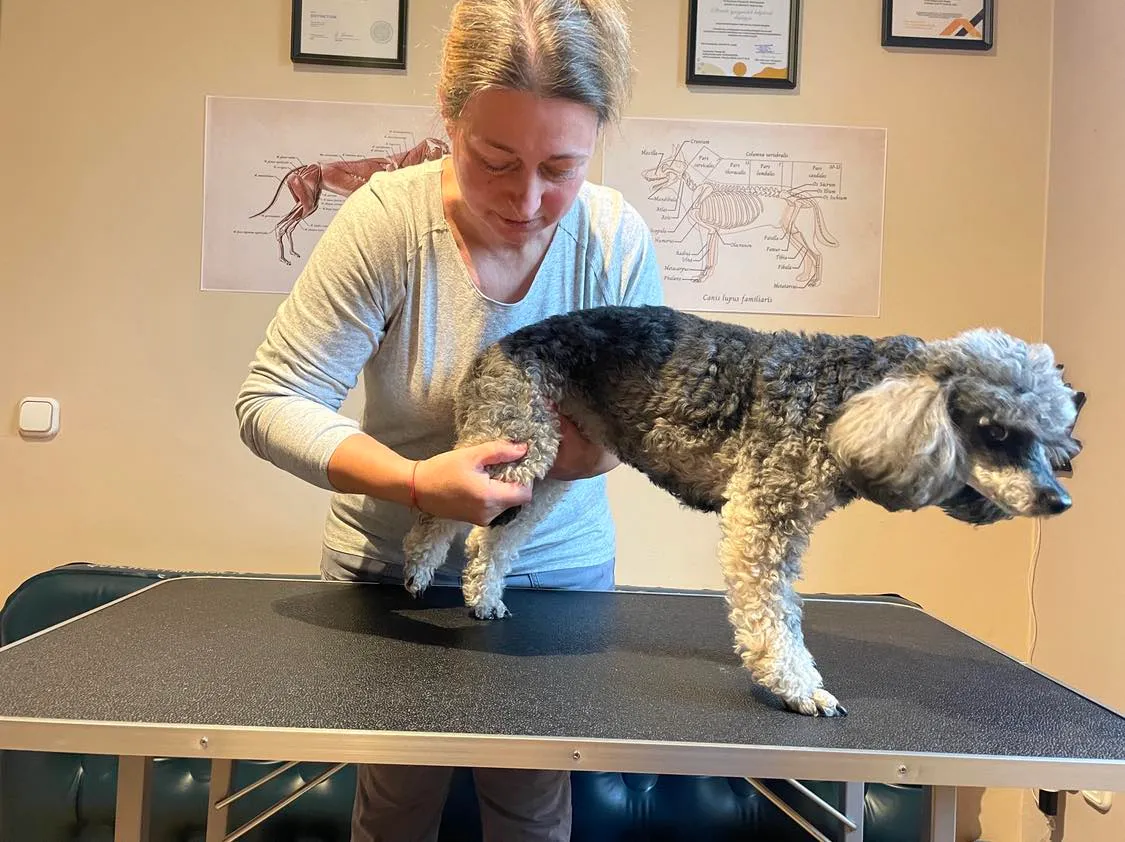
The knee is always examined comparatively, on both sides.
The four grades
Veterinary practice distinguishes four grades of severity. The grade drives the treatment decision, so it is always the vet who establishes it:
- Grade I. The kneecap can be displaced by hand but springs straight back. Usually no complaint.
- Grade II. The kneecap luxates on its own from time to time, returning either spontaneously or when the leg is extended. This is where the skipping step appears.
- Grade III. The kneecap sits out permanently, can be replaced by hand, but slips out again. The dog spares the leg persistently.
- Grade IV. The kneecap sits out permanently and cannot be replaced. Limb posture is visibly altered.
Why it should not be left alone
Every luxation scrapes the cartilage surface. Over years that means wear, and then painful arthrosis — by which point the knee is no longer the only problem.
Meanwhile the dog has learned to spare the affected leg. Weight transfers to the other hind limb and to the forequarters, with two consequences. The sound side is now permanently overloaded, which starts wear there too. And the thigh musculature on the affected side wastes, while the back and lumbar muscles overwork, because that is where the substitute stabilisation comes from. By the time such a dog reaches me, the knee is rarely the whole story.
The cranial cruciate ligament carries a particular risk. Movement along a faulty axis loads it continuously, and ligament rupture is more frequent in dogs living with patella luxation.
What manual therapy can — and cannot — do
It is worth being clear: manual therapy does not correct the anatomy. No amount of handwork changes the depth of the groove or the axis of the bone — where the grade and the symptoms warrant it, the answer is surgical, and that is the vet’s decision.
What it genuinely helps with is balancing the inner and outer thigh musculature, releasing the tension that compensation creates, preserving range of motion, and reducing pain. At the milder grades that often holds the situation stable for years. After surgery it becomes part of rehabilitation: targeted, progressively loaded movement rebuilds the wasted thigh muscle, without which the surgical result will not last either.
In every case we begin from the veterinary diagnosis and a known grade — without them, a treatment plan would be guesswork.