
Why an assessment comes first
Treatment can only begin once we know what your pet can take.
Most of a first appointment is not massage. That surprises people — but it is the part that decides whether the treatment will help at all.
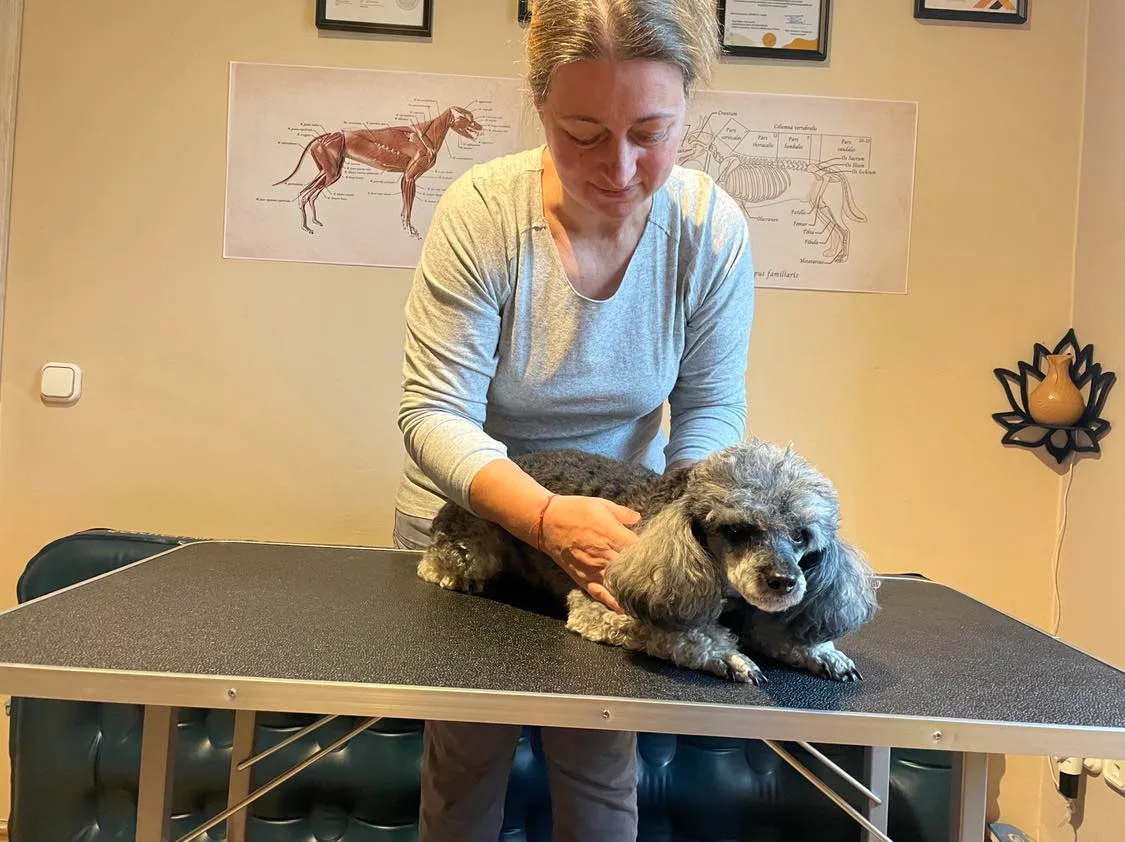
The purpose of the assessment is simple: to find out where your pet actually is. Which muscle groups are tight, which have weakened, what range of motion each joint has, where soreness shows, and how much load it can carry — not in general, but today.
The notes from the assessment are the baseline the next session is measured against.
What I look at
- Case history. Previous surgery, injuries, current medication, the veterinary diagnosis and any results. If there are radiographs, I ask for those too.
- Stance. How the dog stands when it is not paying attention: where its weight sits, whether it loads all four limbs evenly, how it carries its head and tail.
- Movement. At a walk and a trot, in a straight line and on a turn. Lameness is often visible at only one gait.
- Palpation. I work through the musculature by hand: differences in warmth, swelling, knots, changes in muscle tone, and the reaction to soreness.
- Range of motion. I take each joint carefully through its passive range and note where movement stops, and where guarding begins.
- Muscle symmetry. I compare the two sides. A difference in muscle mass shows which limb the animal has been sparing — often for months.
All of it gets written down. The notes are not a formality: next time I compare against them, and that is how we know whether the therapy is working or whether we need to change direction.
Why it cannot be skipped
Because in manual therapy, force applied in the wrong direction does as much harm as doing nothing. Some examples where treatment is contraindicated or must be modified:
- Fever or acute inflammation. Treatment that increases circulation can make things worse.
- A recent, not-yet-stable fracture or surgical site. Here the vet’s clearance and timing govern.
- Tumours. Massaging the affected area is not advised.
- Sudden pain or paralysis of unclear origin. That is an urgent veterinary case, not a therapeutic one.
These are not theoretical risks. It is exactly why I ask for the veterinary diagnosis every time: not out of mistrust, but because the diagnosis is what says what is permitted.
And if there is no diagnosis yet?
Then that is the first step. If your pet has not seen a vet, I write up what the assessment found, and that is the thing to go in with — so the vet can work from concrete observations. Manual therapy is complementary care: it works alongside veterinary treatment, not instead of it.
How long does it take?
A first appointment usually runs 45–60 minutes, about half of it assessment. We come back to a repeat assessment later — typically after four or five treatments — to see what has changed, and whether the plan stands or needs adjusting.