
Manual therapy: dogs and humans
What the two practices share — and where they part ways.
I am often asked whether what I do with dogs is the same as what a massage therapist does with people. The answer: the basis, yes; the practice, no.
The shared part is physiology. Muscle tissue responds to pressure and stretch the same way in both species, circulation improves the same way in the treated area, and the foundations of Swedish massage — effleurage, petrissage, friction — do on a dog what they do on a person. The goals match too: release tension, improve circulation, reduce pain, preserve range of motion.
From there the two practices diverge.
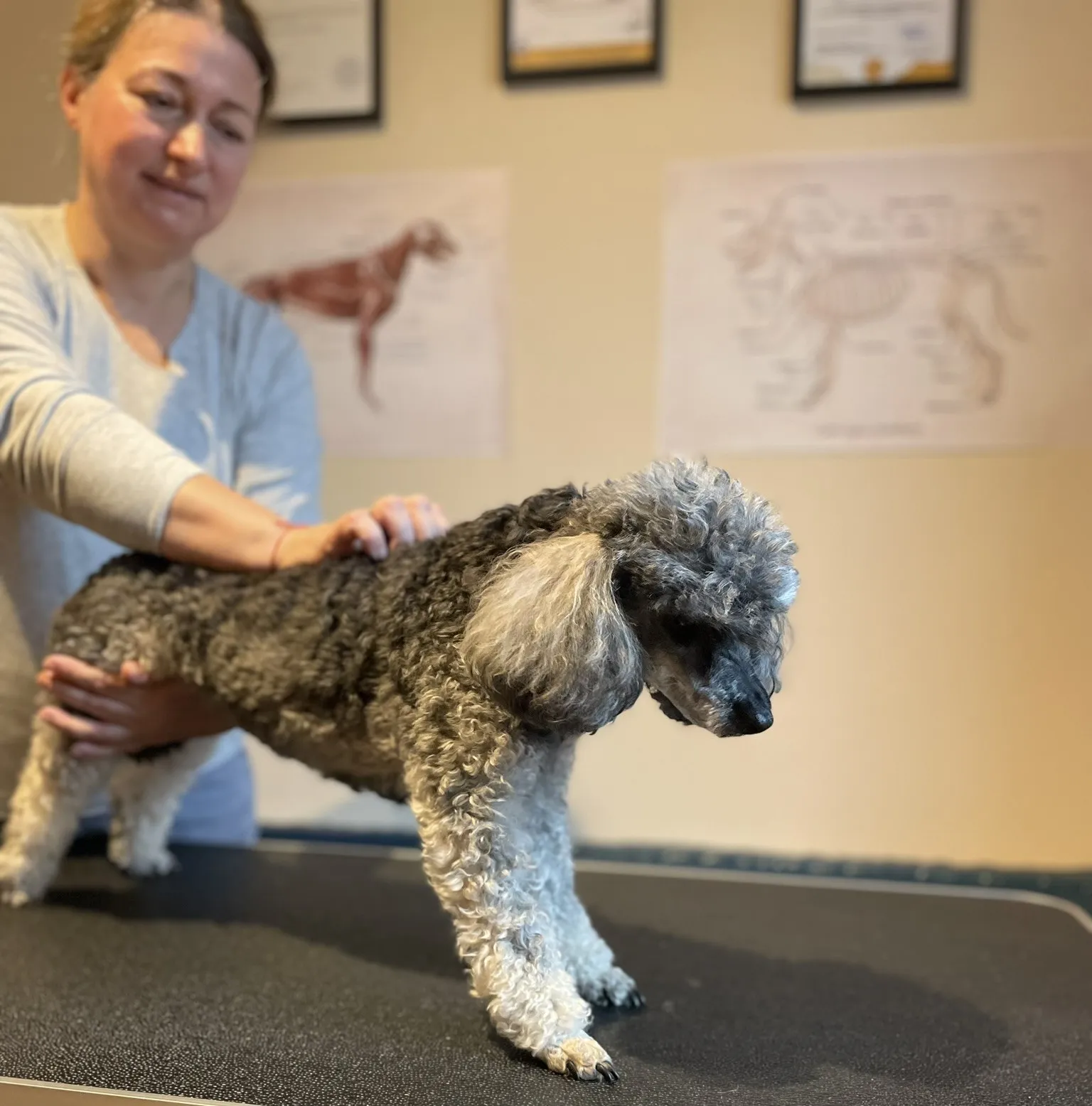
Hand position and pressure differ completely from human practice.
Feedback
This is the biggest difference. A person tells you where it hurts, how much, and whether what you are doing helps. A dog does not. Instead I read posture, breathing, the set of the ears and the corner of the mouth, a small withdrawal, a shift of weight. These signals are subtle, and they appear long before any obvious protest.
It follows that I do not set the pace of the session. If a dog signals that an area is sore, I do not “work through” the tension there — I step back and approach the same muscle chain from elsewhere.
Anatomy
A dog walks on four legs, and roughly sixty per cent of its body weight falls on the forelimbs. So complaints are distributed differently than in people: the shoulder and neck region, and the thoracolumbar junction, carry particular load. It also matters that a dog has no collarbone — the shoulder blade attaches to the trunk through muscle alone, which calls for quite different work around the scapula.
Size is decisive too. The pressure I would use on an adult human calf would simply injure the back musculature of a chihuahua. Grip and pressure always scale to the animal’s body and muscle mass.
Trust
With a person, treatment starts with a conversation. With a dog, it starts with getting acquainted. A good part of the first session is about letting the animal settle into the room, the smells and my hands — and letting it learn that it can step away at any point. You cannot treat a dog that is being held down. A muscle tensed in self-defence will not yield to the grip, and what you get is coercion, not results.
A session therefore runs 45–60 minutes, of which the actual handwork is often less than someone would expect from a human appointment. That is not lost time: work done without trust does not hold until the next session.
What does not transfer
Human physiotherapy protocols look like ready-made recipes, and the literature behind them is far richer. But what is “ten minutes twice a day at home” for a person has to be made acceptable to the dog, turned into a game, and performed correctly at home by the owner. Half of any treatment plan is therefore not about my hands at all — it is about what is realistically achievable at home.